
As of the week ending March 15, XRP defied macro pressures from the oil crisis to strengthen, while the S&P 500 index declined by 1.60%. Meanwhile, CryptoQuant data shows that the 30-day moving average of large whale fund flows for XRP has turned positive for the first time since November 2025, suggesting that major holders may be re-entering accumulation mode.
XRP Outperforms the S&P 500: An Unusual Performance Amid Oil Shock
 (Source: Trading View)
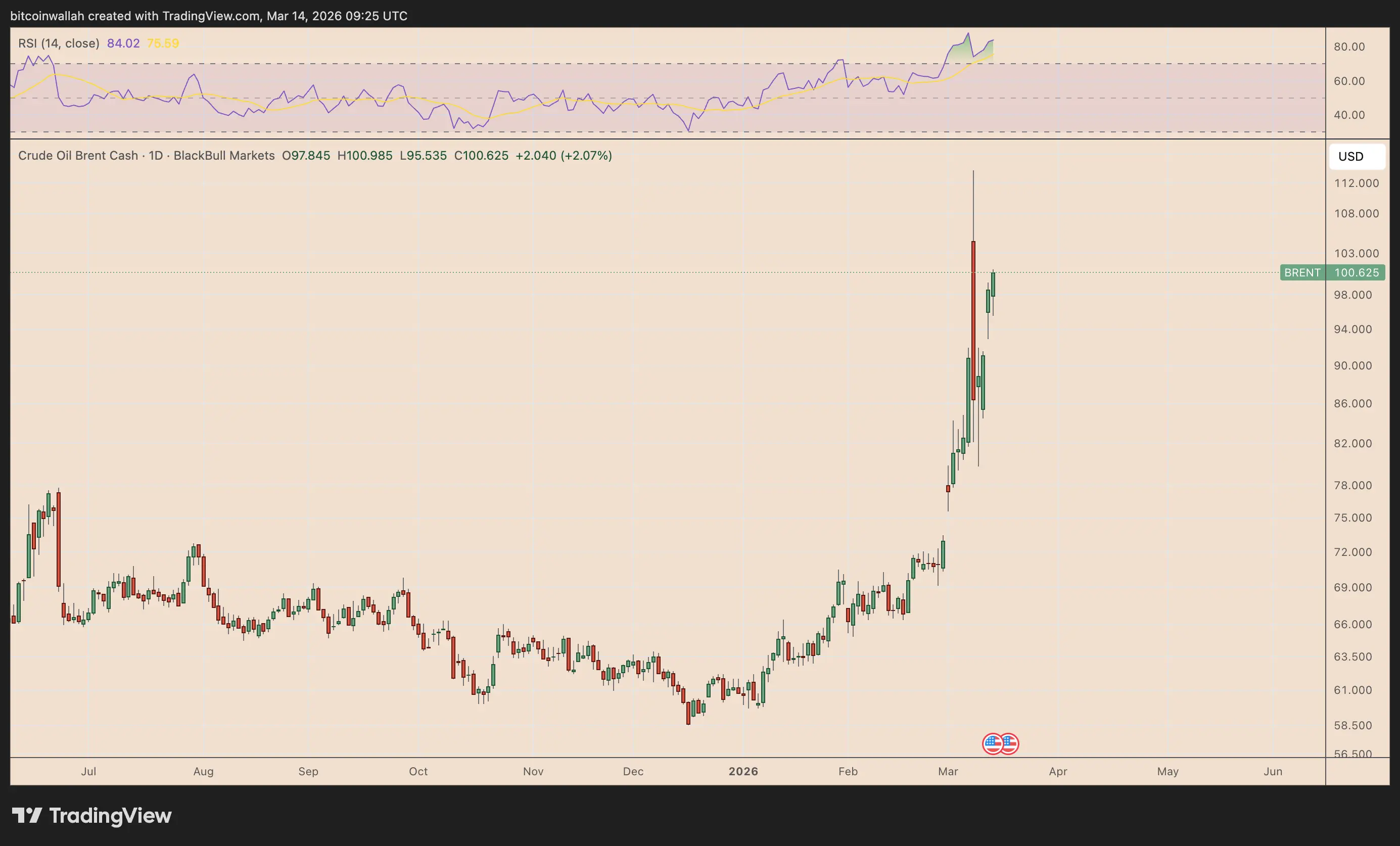
The recent surge in oil prices was driven by geopolitical tensions in Iran and turbulence near the Strait of Hormuz. Brent crude closed at $103.14 per barrel on Friday, up over 11% for the week; US crude briefly surpassed $100 but retreated, closing near $98.71 per barrel.
The spike in oil prices reignited concerns about stagflation—low growth combined with high inflation—placing pressure on traditional risk assets. Investors worry that higher energy costs could force the Federal Reserve to maintain a tightening stance for a longer period.
Against this backdrop, XRP recorded a weekly gain of over 4%, while the overall crypto market and stocks faced selling pressure. XRP’s relative strength performance is particularly noteworthy.
Whale Funds Turn Positive: A Key Technical Signal After 4 Months
 (Source: CryptoQuant)
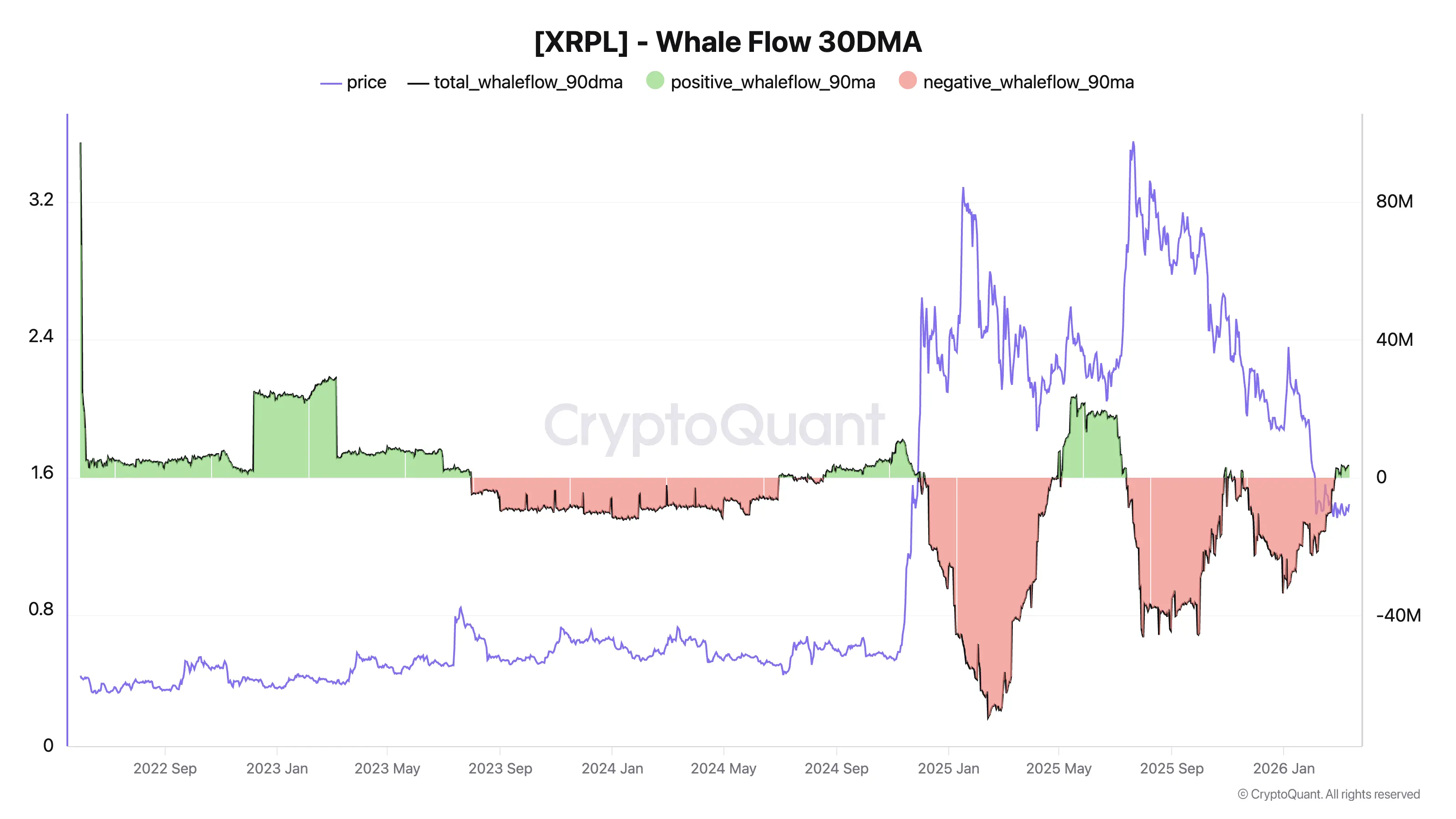
CryptoQuant’s on-chain data shows that XRP whale’s 30-day moving average of fund flows has turned positive for the first time since November 2025, indicating that large addresses holding substantial XRP are experiencing net inflows recently.
Here’s an interpretation of the current whale fund signals:
Early 2026 Peak Outflows: During XRP’s decline from above $3 to just over $1, whale funds experienced continuous net outflows, showing that large holders sold off during market weakness.
Recent Reversal: Fund flows have shifted from negative to positive, typically indicating that large holders are moving from “supply exporters” to “supply absorbers” behavior patterns.
Strength of Signal: Analysts note that this signal is still in early stages and cannot confirm a sustained trend reversal. Historically, whale fund turning positive often coincides with price stabilization or trend reversal.
This data is especially significant given the continued outflows from XRP ETFs—implying that even as institutional ETF channels face capital withdrawals under macro pressures, on-chain large holders may be filling some supply gaps.
XRP ETF: Second Largest Outflow Ever and Long-term Outlook
 (Source: SoSoValue)
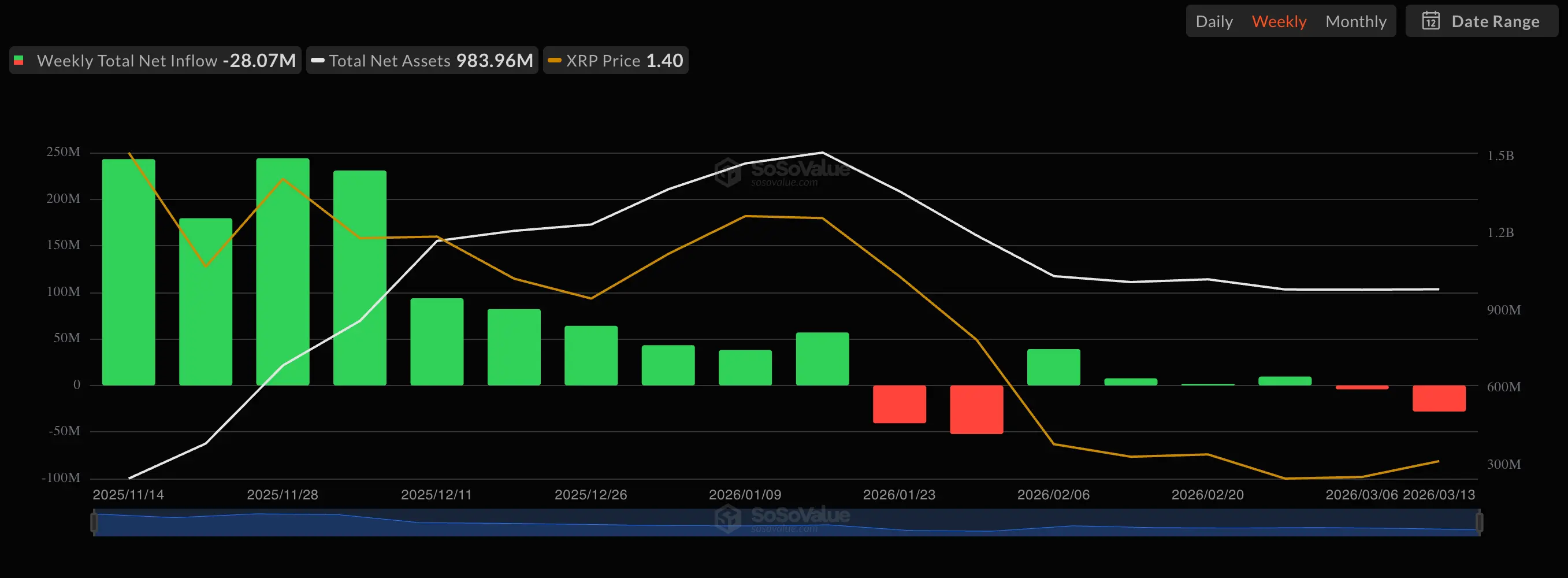
SoSoValue data shows that this week, XRP spot ETF experienced approximately $28 million in net outflows, the second-highest weekly redemption since its launch in November 2025. This outflow occurred amid heightened macro uncertainty and overall crypto market volatility, as institutional investors reduced exposure driven by risk aversion.
Looking at a longer timeframe, XRP ETFs have still accumulated over $1.4 billion in net inflows since launch, indicating that institutional interest in long-term XRP holdings remains intact. Additionally, a major regulatory development occurred during the same week: on March 11, the SEC and CFTC signed a Memorandum of Understanding (MOU), explicitly classifying XRP in the secondary market as a “digital commodity,” consistent with the 2023 Torres ruling and the $50 million settlement agreement in 2025, providing clearer regulatory clarity for XRP spot ETFs’ long-term operation.
FAQs
Why did XRP outperform US stocks during the oil crisis?
XRP’s strong performance may stem from multiple factors: whale re-accumulation near key support levels providing demand support; its regulatory status becoming clearer after the SEC-CFTC MOU, offering a positive catalyst; and the overall crypto market’s reduced sensitivity to oil shocks after significant deleveraging in October 2025, making individual assets more likely to outperform.
Does whale fund turning positive confirm a trend reversal for XRP?
Currently, the signal is still early and insufficient to confirm a trend reversal. The 30-day moving average just turned positive; continued observation over subsequent weeks is needed to see if it remains positive and if broader on-chain activity (such as transfer volume and active addresses) increases. Sustained positive whale flows combined with easing ETF outflows would strengthen the case for a bullish reversal.
What is the actual impact of the SEC-CFTC MOU on XRP?
The MOU establishes a coordinated enforcement and data-sharing framework, most importantly clarifying that XRP in the secondary market is classified as a “digital commodity” (CFTC jurisdiction), not a security (SEC jurisdiction). This classification supports Ripple’s plans for a public listing and provides a more stable legal foundation for the seven XRP spot ETFs currently operating in the US, significantly reducing regulatory uncertainty for XRP holders and investors.
Disclaimer: The information on this page may come from third parties and does not represent the views or opinions of Gate. The content displayed on this page is for reference only and does not constitute any financial, investment, or legal advice. Gate does not guarantee the accuracy or completeness of the information and shall not be liable for any losses arising from the use of this information. Virtual asset investments carry high risks and are subject to significant price volatility. You may lose all of your invested principal. Please fully understand the relevant risks and make prudent decisions based on your own financial situation and risk tolerance. For details, please refer to
Disclaimer.
Related Articles
XRP ETFs Hit $1.5B Inflows After SEC Clarity Unlocks Demand
XRP ETFs saw $1.5 billion in inflows post-regulatory clarity, driven by strong institutional demand and new SEC rules. Major firms increased their holdings, and XRP network activity surged, indicating robust adoption and investor interest in crypto.
CryptoFrontNews2h ago
XRP Price Clears $1.40 While Broader Downtrend Persists
XRP's recent rise above $1.40 indicates a shift in market behavior after a consolidation phase. While momentum indicators show improvement, the broader bearish trend persists, limiting upside potential. Sustained support is crucial for extending its recovery.
CryptoNewsLand6h ago
Tobu Top Tours Launches XRP Ledger-Based Prepaid Payment Platform, Targeting Japan's ¥30T Market
Tobu Top Tours has partnered with SBI Ripple Asia to launch a prepaid token payment platform on the XRP Ledger, gaining regulatory approval in Japan. Set for rollout later this year, it allows users to convert yen into blockchain tokens for various tourism services. SBI Ripple Asia also announced research to enhance Japan-South Korea cross-border payments using the XRP Ledger.
GateNews6h ago
XRP Consolidation Signals Reset as Bullish Setup Emerges
XRP has recently rebounded to $1.39 after trading between $1.20 and $1.40 due to improved market sentiment. A significant drop in futures open interest reflects reduced speculation, while technical indicators suggest a potential bullish breakout, targeting $1.50 and possibly $1.80.
CryptoNewsLand7h ago
Kalshi Traders Forecast XRP to Hit $1.60 in April
Kalshi traders predict XRP will reach $1.60 in April amid rising demand and significant ETF inflows. With a bullish technical outlook and upcoming regulatory votes, XRP's market dynamics show potential for further gains, despite risks of declining support levels if outcomes are unfavorable.
CryptoFrontier13h ago


